Fiber to the home (FTTH) enables the installation of fiber directly from the central point to the end user's home, providing unprecedented high-speed Internet access. There are two types of technologies for implementing FTTH network: AON (active optical network) and PON (passive optical network).
What is AON?
AON is an Active Optical Network, which mainly uses a point-to-point (PTP) network architecture, and each user can have a dedicated optical fiber line. Active optical network means that during the transmission of signals, switching equipment such as routers and switching aggregators, active optical devices, etc. are deployed from the central office to the user distribution unit. These switching equipment are driven by electricity to manage Signal distribution and direction signals for specific customers. Active optical devices include light sources (lasers), optical receivers, optical transceiver modules, optical amplifiers (fiber amplifiers and semiconductor optical amplifiers), etc.
What is PON?
PON is Passive Optical Network, a point-to-multipoint network structure, and is the main technology to realize FTTB / FTTH. Passive optical network refers to ODN (optical distribution network) using only optical fibers and passive components, and only needs to use active equipment at the signal source and signal receiving end. In a typical PON system, the optical splitter is the core, and the optical splitter is used to separate and collect optical signals transmitted through the network. These splitters for PON are bidirectional. In the downstream direction, multiple services such as IP data, voice, and video are distributed by the OLT located in the central office through broadcast, and are distributed through the 1: N passive optical distributor in the ODN To all ONU units on the PON; in the upstream direction, various service information from each ONU is coupled to the same fiber through the 1: N passive optical combiner in the ODN without interference, and finally sent to the OLT at the central office for reception end.
A passive optical network includes an optical line terminal (OLT) installed at the central control office, and a set of supporting optical network units (ONUs) installed at the user end. The optical distribution network (ODN) between the OLT and the ONU contains optical fibers and passive splitters or couplers. PON is divided into three technical standards: APON (ATM PON) based on ATM, EPON (Ethernet PON) based on Ethernet, and GPON (Gigabit PON) based on General Frame Protocol.
In the AON network, users have dedicated optical fiber lines, which is easy for network maintenance, capacity expansion, and network upgrades. And AON network covers a wide range, covering a range of about 100 kilometers; PON networks are usually limited to fiber optic cables up to 20 kilometers. AON mainly guides optical signals through active equipment, and PON uses passive devices without power supply, resulting in AON network deployment higher than PON cost.
As a world leading manufacturer in fiber optic connectivity, plc splitter, wdm, MEMS optical switch, HYC has 20 years of experience to provide end-to-end solutions for FTTx, FTTH applications.
5/21/2020
5/18/2020
Quickly understand FTTx / FTTC / FTTB / FTTH
What is FTTx?
FTTx is "Fiber To The x", which is a general term for various fiber-optic communication networks. X based on the location of the fiber's termination point. Such as x = H (Fiber to the Home), x = O (Fiber to the Office) , x = B (Fiber to the Building). The FTTx technology ranges from the central office equipment to the user terminal equipment, including OLT (Optical Line Terminal), ONU (Optical Network Unit), ONT (Optical Network Terminal).
Depending on the install location of the ONU at the user end of the optical network unit, there are many types of FTTx, which can be divided into fiber to Cabinet (FTTCab), fiber to curb (FTTC), fiber to building (FTTB), fiber to the home (FTTH), fiber to the office (FTTO) and other service forms. US operator Verizon refers to FTTB and FTTH as fiber-to-the-station (FTTP).
FTTCab (Fiber To The Cabinet)
The traditional electric cable is replaced by optical fiber. The ONU is placed at the cabinet. The ONU below uses copper wire or other media to connect to the user.
FTTC (Fiber To The Curb)
Optical cables will be used from the central office to roadsides within a thousand feet of home or offices. Generally, a potential broadband transmission link that is very close to the user is laid first. Once there is a need for broadband services, the fiber can be quickly led to the user and the fiber can be brought home.
FTTB (Fiber To The Building)
It is a broadband access method based on optimized optical fiber network technology, which uses fiber to the building and network cable to the home to achieve the user's broadband access. Generally, dedicated line access is adopted, which is easy to install and can provide a maximum upstream and downstream rate of 10Mbps (exclusive).
FTTH (Fiber To The Home)
FTTH is a type of optical access network application that is closest to the user except the FTTD(Fiber to the Desktop) by installing the ONU in home or business users. PON technology has become a hotspot of global broadband operators, and is considered to be one of the best technical solutions to achieve FTTH.
FTTP (Fiber To The Premise)
FTTP is a North American term. It includes FTTB, FTTC, and FTTH in a narrow sense, and extends optical fiber cables to homes or enterprises.
HYC Co., Ltd(HYC)is a leading passive optical devices OEM ODM manufacturer engaged in R&D, manufacture, and marketing of fiber optical products. Providing professional products and services for fiber connectivity, WDM, PLC splitter, and high-density datacom cabling. HYC products and solutions widely applied in 4G/5G, Data Center and Cloud Computing industry, etc.
www.hyc-system.com
FTTx is "Fiber To The x", which is a general term for various fiber-optic communication networks. X based on the location of the fiber's termination point. Such as x = H (Fiber to the Home), x = O (Fiber to the Office) , x = B (Fiber to the Building). The FTTx technology ranges from the central office equipment to the user terminal equipment, including OLT (Optical Line Terminal), ONU (Optical Network Unit), ONT (Optical Network Terminal).
Depending on the install location of the ONU at the user end of the optical network unit, there are many types of FTTx, which can be divided into fiber to Cabinet (FTTCab), fiber to curb (FTTC), fiber to building (FTTB), fiber to the home (FTTH), fiber to the office (FTTO) and other service forms. US operator Verizon refers to FTTB and FTTH as fiber-to-the-station (FTTP).
FTTCab (Fiber To The Cabinet)
The traditional electric cable is replaced by optical fiber. The ONU is placed at the cabinet. The ONU below uses copper wire or other media to connect to the user.
FTTC (Fiber To The Curb)
Optical cables will be used from the central office to roadsides within a thousand feet of home or offices. Generally, a potential broadband transmission link that is very close to the user is laid first. Once there is a need for broadband services, the fiber can be quickly led to the user and the fiber can be brought home.
FTTB (Fiber To The Building)
It is a broadband access method based on optimized optical fiber network technology, which uses fiber to the building and network cable to the home to achieve the user's broadband access. Generally, dedicated line access is adopted, which is easy to install and can provide a maximum upstream and downstream rate of 10Mbps (exclusive).
FTTH (Fiber To The Home)
FTTH is a type of optical access network application that is closest to the user except the FTTD(Fiber to the Desktop) by installing the ONU in home or business users. PON technology has become a hotspot of global broadband operators, and is considered to be one of the best technical solutions to achieve FTTH.
FTTP (Fiber To The Premise)
FTTP is a North American term. It includes FTTB, FTTC, and FTTH in a narrow sense, and extends optical fiber cables to homes or enterprises.
HYC Co., Ltd(HYC)is a leading passive optical devices OEM ODM manufacturer engaged in R&D, manufacture, and marketing of fiber optical products. Providing professional products and services for fiber connectivity, WDM, PLC splitter, and high-density datacom cabling. HYC products and solutions widely applied in 4G/5G, Data Center and Cloud Computing industry, etc.
www.hyc-system.com
4/27/2020
How to choose: MPO or MTP Fiber Cables?
With the high-speed transmission and data capacity requirements of 40G/100G network cabling in data centers, high-density MPO / MTP fiber connectors and patch cords are used more and more widely. The MPO/MTP fiber optic connector is a multi-core connector that can provide multi-fiber connections in one connector, supporting higher bandwidth and higher density applications. What is the difference between MPO and MTP?
MPO is "Multi-fiber Push On", which is the first-generation shrapnel-clamped multi-core connector developed by Japan NTT Communications Corporation in the 1980s. The size of the MPO connector is similar to the traditional SC connector, but the density has increased several times. 12-core fibers are usually arranged in a row, which can consist of one or more columns of fibers in the same MPO connector. There are 12-core fibers MPO connectors and 24-core fibers MPO connector. There are also 16-core and 32-core fibers MPO connector. An MPO connector can realize the simultaneous transmission of 12-core or more optical fiber signals, which saves a lot of space and resources for optical fiber cabling.
MTP is "Multi-fiber Termination Push-on", which was developed by US Conec and improved attenuation and reflection on the standard MPO connector with higher overall performance. MTP and MPO optical fiber connectors are in compliance with the international standard "IEC-61754-7" and the American standard "TIA-604-5 (FOCIS5)", which means that these two connectors are completely compatible. MTP fiber patch cord is a high-performance MPO connector with more optimized optical and mechanical performance. The appearance design is slightly different, but they can be interchanged and interconnected.
MTP connectors are specially designed to improve performance and usability compared to MPO connectors. The difference between the two mainly includes the following:
1. The outer housing of the MTP connector is designed to be removable, which is convenient for users to reprocess and polish the MT ferrule and flexibly change the positive and negative.
2. The floating ferrule of the MTP fiber connector can improve the transmission performance during mechanical connecting.
3. There is a metal pin clip in the MTP fiber connector to fix the push ring, minimizing the accidental breakage when mating with the connector.
4. The elliptical guide pin (PIN) of the MTP optical fiber connector is made of metal and oval design, which can maintain high-performance transmission more lasting.
MPO / MTP optical fiber connectors are small size, high-density, and can support multi-core optical fiber connections, which saves cabling space. Its flexibility and expandability make cabling easier for network upgrades. HYC can provide various specifications of MPO / MTP optical fiber connectors, optical fiber jumpers, and support OEM / ODM customization.
Founded in 2000, HYC CO., LTD (HYC) is the world’s leading passive optical devices OEM/ODM manufacturer who engages in R&D, producing, marketing and providing service of fiber optical products.
www.hyc-system.com
MPO is "Multi-fiber Push On", which is the first-generation shrapnel-clamped multi-core connector developed by Japan NTT Communications Corporation in the 1980s. The size of the MPO connector is similar to the traditional SC connector, but the density has increased several times. 12-core fibers are usually arranged in a row, which can consist of one or more columns of fibers in the same MPO connector. There are 12-core fibers MPO connectors and 24-core fibers MPO connector. There are also 16-core and 32-core fibers MPO connector. An MPO connector can realize the simultaneous transmission of 12-core or more optical fiber signals, which saves a lot of space and resources for optical fiber cabling.
MTP is "Multi-fiber Termination Push-on", which was developed by US Conec and improved attenuation and reflection on the standard MPO connector with higher overall performance. MTP and MPO optical fiber connectors are in compliance with the international standard "IEC-61754-7" and the American standard "TIA-604-5 (FOCIS5)", which means that these two connectors are completely compatible. MTP fiber patch cord is a high-performance MPO connector with more optimized optical and mechanical performance. The appearance design is slightly different, but they can be interchanged and interconnected.
MTP connectors are specially designed to improve performance and usability compared to MPO connectors. The difference between the two mainly includes the following:
1. The outer housing of the MTP connector is designed to be removable, which is convenient for users to reprocess and polish the MT ferrule and flexibly change the positive and negative.
2. The floating ferrule of the MTP fiber connector can improve the transmission performance during mechanical connecting.
3. There is a metal pin clip in the MTP fiber connector to fix the push ring, minimizing the accidental breakage when mating with the connector.
4. The elliptical guide pin (PIN) of the MTP optical fiber connector is made of metal and oval design, which can maintain high-performance transmission more lasting.
MPO / MTP optical fiber connectors are small size, high-density, and can support multi-core optical fiber connections, which saves cabling space. Its flexibility and expandability make cabling easier for network upgrades. HYC can provide various specifications of MPO / MTP optical fiber connectors, optical fiber jumpers, and support OEM / ODM customization.
Founded in 2000, HYC CO., LTD (HYC) is the world’s leading passive optical devices OEM/ODM manufacturer who engages in R&D, producing, marketing and providing service of fiber optical products.
www.hyc-system.com
12/30/2019
How does FBG (Fiber Bragg Grating) Optical Reflector work?
FBG fiber optic reflector, also known as Fiber Bragg Grating Filter, is usually installed on the front end of the ONU. Combined with OTDR equipment, it can realize the point-to-point (PTP) or point-to-multipoint (PTMP) network monitoring of optical link, which can reflect the network abnormality quickly and accurately.
What is FBG? FBG is Fiber Bragg Grating. A fiber grating is a type of diffraction grating. Fiber Bragg Gratings (FBG) is a simple and low-cost way to build a grating into a specific wavelength range of fiber. When broad-spectrum light is incident on the fiber with built-in grating, the wavelength matching the grating will be reflected back to the input end, and the rest of the light will be passed through to the other end. Fiber gratings have the characteristics of small size, good wavelength selectivity, good compatibility, etc. The manufacturing process for fiber gratings is mature, with good practicality and low cost, they are widely used in the field of communication and sensing and is also ideal important device in optical network.
The FBG optical reflector utilizes the wavelength selectivity of the fiber grating, and the fiber grating is embedded in the adapter. It can be conveniently installed on the front end of an optical network (ONU), and it can quickly and accurately implement optical network fault detection with the help of an optical time domain reflector (OTDR). Due to the excellent wavelength selection characteristics of fiber gratings, anti-electromagnetic interference, the center wavelength drift is small with the change of external temperature, and when the optical network coverage and depth continue to increase, the entire optical network fault point can be detected quickly and accurately.
With the application of optical splitters in passive optical network (PON) networks, the complexity of the ODN network deployment environment has been increased. The splitters at the end of the FTTx will split the trunk optical signals and increase the difficulty to identify attenuation events on ODN branch fibers. The application of fiber grating reflector is a wavelength selective reflector based on this environment, which aims to improve the fast and accurate detection of optical link failure events by OTDR.

The fiber optic reflector is usually installed on the ONU side. The OTDR detects the intensity of the optical signal reflected by this reflector and compares the return loss between the normal line and the failed link to determine whether the optical fiber in the link is damaged or not. The normal PON system working wavelength does not meet the reflector conditions then will pass through the reflector with a small attenuation. While the reflector achieves the monitoring function, but without disturbing the transmit. 1650nm fiber grating reflector, the grating reflection wavelength is 1645 ~ 1650nm. The optical signal in this Bragg wavelength range will return along the input path, and all other wavelengths of light (1260 ~ 1625nm) can pass through. If the input optical signal segment can detect the fiber grating reflection peaks in this band, it can be judged that the transmission path is normal. Otherwise, it is abnormal.
End-to-end OTDR measurement from the OLT to the ONT is usually difficult because the splitter brings high losses and complex networks. The application of fiber optic reflector is a cost-effective solution to help OTDR detection, and it is the best way to implement real-time end-to-end (OLT to ONT) monitoring of optical networks in FTTx networks.
HYC’s self-developed FBG fiber optic reflector has the advantages of low insertion loss, high reflectivity, and easy installation. It is widely used in PON networks, OTDR testing, central computer room testing, FTTX and other fields. It can be customized as special pigtail or adapter type, and the connector interface is LC, SC APC / PC.

12/09/2019
HYC Innovative Product, 1×48 MEMS Optical Switch
The upcoming 5G application promotes the upgrade of the all-optical network (AON). As a key part of the all-optical network, the ROADM market is expected to usher in rapid growth, especially in metropolitan area networks.
MEMS optical switch is one of the core devices in ROADM. Optical switch is a kind of optical path controlling device, with the ability to control and switch the optical path. MEMS fiber optic switches are based on micro-electro-mechanical system (MEMS) technology, which achieved low insertion loss and highly repeatability by rotating the mirror of MEMS chip.
12/06/2019
Fiber Optic Patch Cable PC, APC or UPC
To make better contact between the ends of the two fibers, the ferrule end faces of the fiber optic patch cable is usually polishing into different structures. Standard polishing methods are PC, APC, and UPC. PC/APC/UPC represents the front end structure of the ceramic ferrule.
Different fiber end face finishes
PC (Physical Contact).The two end faces are polished to be slightly curved or microspherical, and the fiber core is at the highest point of the bending. This eliminates the air gap and forces the fibers into physical contact.
UPC (Ultra Physical Contact) is based on the PC to optimize the end face polishing and surface finish, the end face looks more dome-shaped. The end face of the UPC connector is not entirely flat, and there is a slight arc to achieve more accurate connecting.
APC (Angled Physical Contact). The end face of APC is usually polishing into an 8-degree angle. The 8° angled bevel makes the fiber end face tighter and reflects light through its beveled angle to the cladding instead of returning directly to the source, providing better connection performance.
Different physical appearance
The APC fiber optic connector is usually green. UPC/PC connectors are easily identified by their blue color on the connector boot.
Insertion loss and return loss
Different polishing styles determines the quality of optical fiber, which results in different performances regarding the connector's insertion loss and return loss. Insertion loss refers to the signal loss caused by the connector or cable. In general, the typical insertion loss of PC, UPC, and APC connectors should be less than 0.3dB. Compared with APC connectors, UPC connectors are usually easier to achieve low insertion loss due to the smaller air gap. Insertion loss can also be caused by a tiny particle of dust trapped between the connector end-faces. A single dry debris particle could even damage the fibers and ferrules.
Return loss, also known as reflection loss, is a parameter representing the signal reflection performance. Usually expressed in negative dB value, the higher the value of the setting, the better. The end faces of APC connectors are beveled, so the return loss of APC connectors is usually better than UPC connectors. In general, the return loss of the PC fiber cable is -40dB. UPC return loss is higher relative to PC, generally at -55dB (or even higher). APC industry-standard return loss is -65dB. With the UPC connector, any reflected light is directly reflected back to the light source. The beveled end face of the APC connector allows the reflected light at an angle into the cladding instead of reflecting it directly to the light sources. This is the main factor that causes the return loss to differ.
Applications
PC is the most common grinding method for optical fiber connectors, which is widely used in telecommunication operator equipment. UPC is commonly used in Ethernet network equipment (such as ODF fiber distribution frames, media converters and fiber switches, etc.), digital, cable television and telephone systems. APC is generally used in optical radio frequency applications such as CATV, and also in passive optical applications, such as PON network structures or passive optical local area networks.
Connector connections need to be in the same end face structure; for example, APC and UPC cannot be mated together , because doing so will resulting in poor connector performance. However, the end faces of PC and UPC fibers are flat, and the difference is in the quality of grinding. Therefore, the mixed connection of PC and UPC will not cause permanent physical damage to the connector.
HYC has 19 years of experience in research and development of fiber optic component manufacturer , supplying all kinds of fiber connectors and fiber patch cords for various specifications.
Different fiber end face finishes
PC (Physical Contact).The two end faces are polished to be slightly curved or microspherical, and the fiber core is at the highest point of the bending. This eliminates the air gap and forces the fibers into physical contact.
UPC (Ultra Physical Contact) is based on the PC to optimize the end face polishing and surface finish, the end face looks more dome-shaped. The end face of the UPC connector is not entirely flat, and there is a slight arc to achieve more accurate connecting.
APC (Angled Physical Contact). The end face of APC is usually polishing into an 8-degree angle. The 8° angled bevel makes the fiber end face tighter and reflects light through its beveled angle to the cladding instead of returning directly to the source, providing better connection performance.
Different physical appearance
The APC fiber optic connector is usually green. UPC/PC connectors are easily identified by their blue color on the connector boot.
Insertion loss and return loss
Different polishing styles determines the quality of optical fiber, which results in different performances regarding the connector's insertion loss and return loss. Insertion loss refers to the signal loss caused by the connector or cable. In general, the typical insertion loss of PC, UPC, and APC connectors should be less than 0.3dB. Compared with APC connectors, UPC connectors are usually easier to achieve low insertion loss due to the smaller air gap. Insertion loss can also be caused by a tiny particle of dust trapped between the connector end-faces. A single dry debris particle could even damage the fibers and ferrules.
Return loss, also known as reflection loss, is a parameter representing the signal reflection performance. Usually expressed in negative dB value, the higher the value of the setting, the better. The end faces of APC connectors are beveled, so the return loss of APC connectors is usually better than UPC connectors. In general, the return loss of the PC fiber cable is -40dB. UPC return loss is higher relative to PC, generally at -55dB (or even higher). APC industry-standard return loss is -65dB. With the UPC connector, any reflected light is directly reflected back to the light source. The beveled end face of the APC connector allows the reflected light at an angle into the cladding instead of reflecting it directly to the light sources. This is the main factor that causes the return loss to differ.
Applications
PC is the most common grinding method for optical fiber connectors, which is widely used in telecommunication operator equipment. UPC is commonly used in Ethernet network equipment (such as ODF fiber distribution frames, media converters and fiber switches, etc.), digital, cable television and telephone systems. APC is generally used in optical radio frequency applications such as CATV, and also in passive optical applications, such as PON network structures or passive optical local area networks.
Connector connections need to be in the same end face structure; for example, APC and UPC cannot be mated together , because doing so will resulting in poor connector performance. However, the end faces of PC and UPC fibers are flat, and the difference is in the quality of grinding. Therefore, the mixed connection of PC and UPC will not cause permanent physical damage to the connector.
HYC has 19 years of experience in research and development of fiber optic component manufacturer , supplying all kinds of fiber connectors and fiber patch cords for various specifications.
11/22/2019
Introducing MPO/MTP Fiber Patch Cord,Optical Fiber Connector
With the increasing demand for high-speed, high-capacity optical communication systems, MTP/MPO fiber optic connectors and fiber optic patch cord are ideal solutions for high-density cabling in data centers due to their cores, small size, and high transmission rate.
The MPO fiber patch cord is a combination of an MPO connector and a fiber optic cable. The MPO connector type is distinguished by several factors according to IEC 61754-7: Array Number, Male-Female, Polarity, Polishing type (PC or APC).
MPO fiber optic connector types
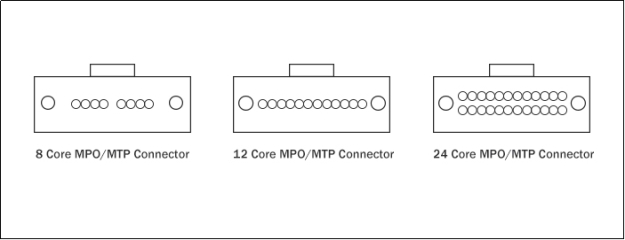
Currently, the factory termination assembly of the MPO connector can accommodate 6 to 144 fibers, among which 12 and 24-core MPO connectors are the most common types. According to IEC-61754-7 and EIA/TIA-604-5 (FOCIS 5) specifications, 12-core fibers are usually arranged in a row, which can consist of one or more columns of fibers in the same MPO connector. There are 12-core fibers MPO connectors and 24-core fibers MPO connector. 40G MPO-MPO fiber jumper generally adopts 12-core MPO multi-mode ferrule; 100G MPO-MPO fiber jumper, generally uses 24-core MPO ferrule. There are also 16 single-row fiber array types on the market that can be divided into multiple columns to form 32 cores or more. The 16/32-core MPO fiber optic connector will be the best solution for low-latency, the ultra-high-speed transmission of next-generation 400G networks.

Male and Female Connectors
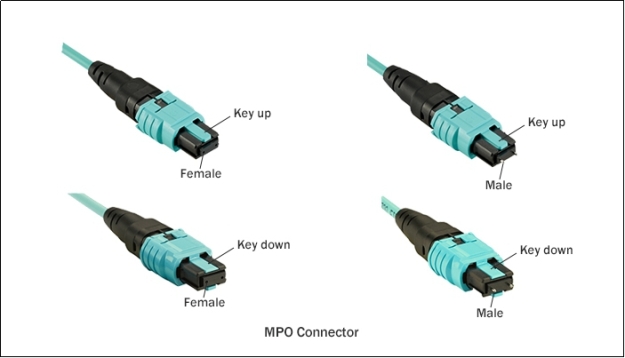
MPO connectors contain several parts such as boot, coupling/housing assembly, ferrule, guide pins, and so on. Because of difference pins types, the MPO connector can be either male or female. The male connector has metal guide pins to ensure fiber alignment when mating while the female connector has no pins. These pins make sure that the connector fronts are precisely aligned on contact and that the fibers’ end-faces aren’t offset.

What is MTP?
MTP is “Multi-fiber Termination Push-on”, which was developed by US Conec and improved attenuation and reflection on the standard MPO connector with higher overall performance. Externally, there is little discernible difference between the MPO and MTP connectors. They are completely compatible.
MPO/MTP fiber connectors and fiber patch cords provide a simple and easy-to-manage fiber-optic cabling solution for FTTH and data centers that require high-density integrated fiber-optic system. It is likely to be a hot-demand product for future 5G data center construction.

HYC has 19 years of experience in research and development of passive basic components for optical communications, supplying MPO/MTP fiber connectors and fiber patch cords of various specifications.
Subscribe to:
Posts (Atom)